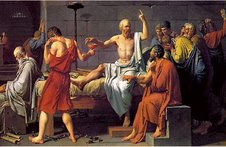
Poor Cassandra, the Trojan prophetess, was condemned never to be believed after having turned down the advances of Apollo. She foresaw the plight of Troy and her death in Agamemnon's bath but could never avert her country's (or her own) sad fate. Bloggers often share Cassandra's catastrophist tendencies, although it remains to be seen whether our own worst fears are wildly speculative fantasy or a grim reality which many of our contemporaries shirk from confronting.
What does this highly pessimistic mindset indicate? Is it a valuable voice of discontent that can stop things disintegrating before they are too late or the last cries of a dying civilization? I have heard some say that Blogging compares with the pamphleteers of the Seventeenth Century who supposedly turned the world upside down during England's brief republic. The comparison brings together the crumbling of barriers to publication that in times prior to 1639 were set up by strict blasphemy laws and an authoritarian Monarchy, and nowadays, by a press that have caved in to an oafish populism and subservience to a court whose information they depend on for advancement. Our press have found out they have backed a bunch of liars and middle managers whose only solution to our problems seem to be to rename things, yet they seemingly cannot summon any way to effectively criticise the magicians who so wowed them at first with their presentational skills. At the same time the public over the last 10 years has had a complicated lesson in the power of Newspeak and simultaneously a medium has arrived which allows us to express what we think to one another bypassing the contented and lack-lustre news-gathering middleman.
This is in some ways what I would like to think, but I also worry that the sheer scope of the internet and the failure to fully discuss issues can mean this new medium has several flaws. It is incredibly surprising, for instance, how quickly some on the internet launch in to attacks, not on the arguments of others, but their personal characters. This might just be a direct consequence of the enraged silenced masses who have had a new medium open up allowing them to say what they really think. Yet how will any of this change policy and how do we hold government to account as the minutiae of the latest acts and trends at Westminster are overlooked even as distrust spreads like a cancer? The detail and the professionalism of traditional news reporting is scrapped and instead disparate bits of information, are discussed all over the web with far greater interest then the irrelevances of celebrity gossip, yet often lacking the contemporaneity we would demand from a traditional news feature. This is great news for minority interests, but could it also mean that as the traditional news institutions crumble from the levelling effect (produced by millions tapping away at their computers, eschewing the tittle-tattle that even the serious press have now stooped to publishing) the net result will be worse, for the sea of information will carry on expanding and we will have no way of checking its veracity.
The problem with our attempt to take on the grand themes is that the Cassandra complex will arise. Looking at the world we will in general see many horrendous things. I have simply talked of the new changes I see afoot in the information age, and part of me surges with optimism yet other doubts envelop me. If we are all talking together and expressing similar doubts why is it that nothing seems to change? Could it be that the groups we form on the net, like in life, are largely self-selecting and that the grave doubts we so often express are not perceived by millions of our other fellow men? Is the net full of sound and fury, signifying nothing?
Wednesday, January 17, 2007


Monday, January 8, 2007
What does our navy do?
As a very ignorant civvie I've failed to get overly worked up by the funding cuts of our navy. In fact, rather like the Chancellor I think a good segment of the £40 Billion deficit could be wiped out by scaling down investment in the armed services, especially the navy. So I found this article to the contrary by Max Hastings of interest. Hastings must be one of the more eccentric and talented writers to have been conscripted to the Guardian team since civil liberties became top of the agenda for the 21st Century; rather than the boringly entrenched debates between left and right about redistribution. Yet Hastings also serves that nice role of providing the unwashed masses who read the Graun (such as myself) a bit of the Torygraph point of view as to how Britain should continue to rule the waves. His argument takes the line that we underfund the armed forces at our peril, as the quality of the soldiers will go down. Yet despite this argument why do we need a navy of the size we do and what does it serve? As the front page of the Telegraph stated a few days ago (in a piece ironically in defence of the navy, revealing the funding cuts), the last time we used its full capacity was the Falklands War. Are there any better reasons to retain the navy and what are they?
Tuesday, January 2, 2007
The limits of my language are the limits of my world (or can we think beyond language?)
Having taken a healthy 2 week holiday away from blogging to stuff my face on Spanish christmas fare and demolish my liver it is a bit daunting to be back in the UK having to face exams and the baying crowds (my definition is the 3+ variety) who visit this blog in search of a grammatical, or, heaven forbid, a logical mistake!
Which brings me to my good friend Mr. Wittgenstein, whose wonderful, if impenetrable book, the Tractatus Logico-Philosophicus woke me from my dogmatical slumbers in bed. The bracketed comment in the title above, is mine, and is the thought that tortures anyone who enters in to Witt's philosophical world. Is life just language or is there something that can be thought about outside language? If you're a french philosophe of the Derrida school the first might seem an attractive option, but if, like me, you're of the romantic and yet realist persuasion that we are not all created constructs of the language that we use, the fact that Witt, in this famous passage seems to endorse the idea that there is no world outside of language can be terrifying. Does he really mean what he says? What kind of world do animals inhabit? Is he just dead wrong or is there something profound lurking in the words of the zen master? Let's face it, whatever is going on in the Tractatus is very odd and the definition of "world" is queer to say the least, but the book holds such endless fascination that even such opaque pronouncements are set to torture the unwitting reader for years to come. Damn book, I wish that philosophy didn't have the capacity to give a person nightmares even once the reading matter has been laid down many years ago and lost somewhere in one's room! Yet isn't that the fun of it?
Which brings me to my good friend Mr. Wittgenstein, whose wonderful, if impenetrable book, the Tractatus Logico-Philosophicus woke me from my dogmatical slumbers in bed. The bracketed comment in the title above, is mine, and is the thought that tortures anyone who enters in to Witt's philosophical world. Is life just language or is there something that can be thought about outside language? If you're a french philosophe of the Derrida school the first might seem an attractive option, but if, like me, you're of the romantic and yet realist persuasion that we are not all created constructs of the language that we use, the fact that Witt, in this famous passage seems to endorse the idea that there is no world outside of language can be terrifying. Does he really mean what he says? What kind of world do animals inhabit? Is he just dead wrong or is there something profound lurking in the words of the zen master? Let's face it, whatever is going on in the Tractatus is very odd and the definition of "world" is queer to say the least, but the book holds such endless fascination that even such opaque pronouncements are set to torture the unwitting reader for years to come. Damn book, I wish that philosophy didn't have the capacity to give a person nightmares even once the reading matter has been laid down many years ago and lost somewhere in one's room! Yet isn't that the fun of it?
Monday, December 18, 2006
Merry Christmas from Spain
To fully enjoy my first Spanish Christmas with the in-laws I´ll be setting aside my keyboard until January 2. Madrid is very lively at the moment for the madrileños know how to to party in the run-up to the festive period. I had a home-cooked Paella yesterday and I will be having problems curbing what the Spanish call La Curva de Felicidad (literally the curve of happiness but referring to the stomach that newly married men acquire) as I am plied with fine wines and all sorts of food. There is a leg of Jamón Ibérico (almost certainly the best ham on earth) and the collection of cured meats kicking around the house look quite exquisite.
Feliz Navidad, as they say in Spain!
Feliz Navidad, as they say in Spain!
Thursday, December 14, 2006
Taking Charity Seriously
Many of us, myself included, do not donate to charities as much as they should. In the day-to-day battle to get through life, earn a living, pay taxes, fund holidays and buy a new computer, charitable causes can often be overlooked. An argument given by perspectives that oppose high rates of tax is that the funds colourlessly taken by the taxman in the UK end up in Whitehall and local government to be squandered by inefficient and lazy officials. If this rate were lower not only would it take away the disproportionate power wielded by civil servants and politicians but the bonus we are told will happen is we will suddenly become philanthropists. Bill Gates is often toted as the role model example. The Microsoft millionaire will solve Africa’s problems with his money and the value of entrepreneurs being allowed to get on with business away from the dead hand of the state and its ridiculous regulations will finally be proved.
Despite its growth throughout New Labour’s troubled time in power, the state is in disrepute, to the extent that this friendly Economist-style argument to strip it back can tempt those such as myself who love the ideal of the Welfare State. For welfare is in disrepute. In the UK, the NHS, the pensions systems, our schools and the welfare system in general are facing spiralling problems that our politicians shirk from confronting. Bullish critics of the system point to the even more depressing decline of the French and German economies who didn’t go through the seemingly brutal slash and burn dismantling by Thatcher of the unions and her basic call to put business first. It can seem despite our prosperity that we may well be entering the end of a golden age which provided health provision free at the point of care for everyone and was meant to educate all,
To take one key example, the way modern healthcare has progressed also means it has become astronomically expensive. The NHS has serious difficulties providing a free service of the quality we demand and the only way we can supplement it for certain minority problems is by charitable donation. The new doctors’ contract is the second time a Labour government have stuffed their mouths with gold in order to keep this vital heart of the country’s health service on-side. It has succeeded in keeping the NHS plugging on, but, as many of us realise, the £1.2 billion deficit must be related to nearly doubling the salary of the highest paid members of the workforce as well as the cost of our astounding technological advances. The demands on the state to control the spiralling costs of this organisation are shirked by our leaders who realise the political suicide it is to try to bring this spending to heel but who will also refuse to put up taxes.
Come the time, come the individual and it seems it has to be our responsibility to begin taking charities seriously just because the terror our leaders face on the deadly tight-rope, they walk between providing high-quality services and keeping the economy ticking over, looks like it might lead to a catastrophic fall radically changing the basic services we hold dear. The Economist-style argument above has too much faith in private companies, for as we know from bitter experience the profit motive when treated as a religion can often sabotage the basic humanity of many and seems to lead to a fetishization of money, where need is ignored and commodities are endlessly desired. Yet sadly due to the way that governments function, characterised by a refusal to take hard decisions that may displease the multi-faceted group that elects them, yet finally annoying everyone, means that we better have faith in philanthropy because the state is in trouble.
Thank you to Angela Francesco for fearlessly raising the topic of charity and Huntington’s Disease on Frank Fisher’s crazy blog. Huntington’s is an example of a disease for which drug companies are unwilling to fund research in to a potential cure because of its rarity and therefore profitability. Donations to her charity jump to raise money for the disease can be made by contacting her by e-mail at angela_octopus@yahoo.co.uk. Her blog documenting her mother’s mental decline and her attempts to deal with the disease can be found here http://survivinghuntingtons.blogspot.com/.
Despite its growth throughout New Labour’s troubled time in power, the state is in disrepute, to the extent that this friendly Economist-style argument to strip it back can tempt those such as myself who love the ideal of the Welfare State. For welfare is in disrepute. In the UK, the NHS, the pensions systems, our schools and the welfare system in general are facing spiralling problems that our politicians shirk from confronting. Bullish critics of the system point to the even more depressing decline of the French and German economies who didn’t go through the seemingly brutal slash and burn dismantling by Thatcher of the unions and her basic call to put business first. It can seem despite our prosperity that we may well be entering the end of a golden age which provided health provision free at the point of care for everyone and was meant to educate all,
To take one key example, the way modern healthcare has progressed also means it has become astronomically expensive. The NHS has serious difficulties providing a free service of the quality we demand and the only way we can supplement it for certain minority problems is by charitable donation. The new doctors’ contract is the second time a Labour government have stuffed their mouths with gold in order to keep this vital heart of the country’s health service on-side. It has succeeded in keeping the NHS plugging on, but, as many of us realise, the £1.2 billion deficit must be related to nearly doubling the salary of the highest paid members of the workforce as well as the cost of our astounding technological advances. The demands on the state to control the spiralling costs of this organisation are shirked by our leaders who realise the political suicide it is to try to bring this spending to heel but who will also refuse to put up taxes.
Come the time, come the individual and it seems it has to be our responsibility to begin taking charities seriously just because the terror our leaders face on the deadly tight-rope, they walk between providing high-quality services and keeping the economy ticking over, looks like it might lead to a catastrophic fall radically changing the basic services we hold dear. The Economist-style argument above has too much faith in private companies, for as we know from bitter experience the profit motive when treated as a religion can often sabotage the basic humanity of many and seems to lead to a fetishization of money, where need is ignored and commodities are endlessly desired. Yet sadly due to the way that governments function, characterised by a refusal to take hard decisions that may displease the multi-faceted group that elects them, yet finally annoying everyone, means that we better have faith in philanthropy because the state is in trouble.
Thank you to Angela Francesco for fearlessly raising the topic of charity and Huntington’s Disease on Frank Fisher’s crazy blog. Huntington’s is an example of a disease for which drug companies are unwilling to fund research in to a potential cure because of its rarity and therefore profitability. Donations to her charity jump to raise money for the disease can be made by contacting her by e-mail at angela_octopus@yahoo.co.uk. Her blog documenting her mother’s mental decline and her attempts to deal with the disease can be found here http://survivinghuntingtons.blogspot.com/.
Friday, December 8, 2006
Last Days
Here is a hypothetical scenario from anticant - "You are reliably informed that you are going to die twelve months hence, and that for the first eleven of them you will remain strong and healthy.What are you going to do during that time that you have long wanted to, but have been repeatedly putting off because of all the hum-drum pressures of daily living?"
My wife and I have several plans which would need to be accomplished in that time.
We would like to go to Northern Spain doing an eating and cultural tour from Galicia to Catalunya. The inverse pilgrimage to Santiago de Compostela. Galicia is famous for having the best shellfish in Spain and we would gorge ourselves on Oysters and the Spanish delicacy Percebes, which is a goose-neck barnacle and the Galician variant is so expensive I have never tried it. Other highlights along the way would include the Basque country's unsurpassed Tapas, a stop off in Rioja, walking in Asturias and the beautiful Spanish monasteries and towns of the north.
Ana is desperate to see the tomb of her favourite poet, Luis Cernuda, in Mexico City, so we would need to head there after our three months in Northern Spain. I would love to go back to Palenque in Chiapas and Tikal in Guatemala (both of which I visited on a gap year at 18) allowing us to explore the magic of Central America together. Perhaps we could settle in the countryside of Guatemala for a few months so I could finish and publish my novel, The Man whose Face was Grey (it's on-the-go and I will hopefully finish it by the end of next year) while living in relative isolation.
Then we would head to China where my brother lives and visit him. Something we've failed to do due to lack of funds but I guess this whole expedition of world tourism could be paid for using all the reserves we had in the bank. Exploring China, and Asia generally, would be an alien and novel way to enjoy the last few months of my existence.
Finally I would like to have a good reunion at the end of the 11th month with all my friends and family toasting the crazy joy of life and saying goodbye. Then presumably I would wallow in bed with requiem music playing, watching Bergman films and pondering with Ana why it all has to end.
Feel free to try this thought-experiment out but I have no intention of press-ganging or nominating anyone for fear of sardonic comments.
My wife and I have several plans which would need to be accomplished in that time.
We would like to go to Northern Spain doing an eating and cultural tour from Galicia to Catalunya. The inverse pilgrimage to Santiago de Compostela. Galicia is famous for having the best shellfish in Spain and we would gorge ourselves on Oysters and the Spanish delicacy Percebes, which is a goose-neck barnacle and the Galician variant is so expensive I have never tried it. Other highlights along the way would include the Basque country's unsurpassed Tapas, a stop off in Rioja, walking in Asturias and the beautiful Spanish monasteries and towns of the north.
Ana is desperate to see the tomb of her favourite poet, Luis Cernuda, in Mexico City, so we would need to head there after our three months in Northern Spain. I would love to go back to Palenque in Chiapas and Tikal in Guatemala (both of which I visited on a gap year at 18) allowing us to explore the magic of Central America together. Perhaps we could settle in the countryside of Guatemala for a few months so I could finish and publish my novel, The Man whose Face was Grey (it's on-the-go and I will hopefully finish it by the end of next year) while living in relative isolation.
Then we would head to China where my brother lives and visit him. Something we've failed to do due to lack of funds but I guess this whole expedition of world tourism could be paid for using all the reserves we had in the bank. Exploring China, and Asia generally, would be an alien and novel way to enjoy the last few months of my existence.
Finally I would like to have a good reunion at the end of the 11th month with all my friends and family toasting the crazy joy of life and saying goodbye. Then presumably I would wallow in bed with requiem music playing, watching Bergman films and pondering with Ana why it all has to end.
Feel free to try this thought-experiment out but I have no intention of press-ganging or nominating anyone for fear of sardonic comments.
Wednesday, December 6, 2006
Ours is not to reason why?
How do we escape the banal pressures of this world? Keeping integrity and being a journalist (or pursuing many other professions, I chose journalism because it’s what I’m doing) seem to be mutually exclusive in this world. Why do we stand for it?
The general logic seems to go like this, so young and upcoming person, to get to a position where you might do something useful you first need to do something that is totally pointless, and another, and another… until you feel the crazy need to perpetuate this Sisyphean cycle of pointlessness.
As a writer the development of blogging has to be regarded as an exciting development simply because of the gradual capitulation of many publications to faff. That this faff is driven by a commercial agenda must be true because it is not the case that the readers stand anything to gain from it. When we buy something to read, our desire to consume things is generally latent in comparison to our desire to be provided with interesting objective information. Yet, even when we buy Time Out or some other listings magazine we want it to provide honest opinion.
Recently one of my journalism lecturers was explaining the way the advertising department and editorial in local papers combine in an effort to tie in the article with a commercial interest. Potential clients drive this trade to the extent a bad review of a restaurant will lead to a stern word from the advertising department. As a reader knowing this, would you want to take the advice of this magazine as to where to eat? Surely, you would begin to realise that the publication only ever writes good reviews. Also, if you ever went to a place that was genuinely bad on the recommendation of an article you would not trust the source again. Even the advertisers lose in the long term with such a policy, for the publication, having been dismissed as useless, will be consigned to the dustbin and any true opinion will be treated with scepticism.
The modern journalist keen to write about things in the world that actually matter, but determined to earn his shilling, is in a dilemma. Endless publications flourish perpetuating cynicism towards the trade, yet because they agree to act as the Pravda of certain companies, these bulldozers of the Amazon for Amazon provide the starving journo with a ready source of cash. On the other hand, the journo can launch out to limbo trying to carve out a precedent of value but with few means of publishing or being provided with payment. The latter has to be the noble option, yet the cycle of madness and its control over us can sometimes seem inevitable. To the writer sitting shivering in the garret the temptation of writing for the quick buck can be overwhelming in the desperation to survive and be read. He reaches for his quill agonized by the way his ideas only seem to have an outlet if they are used to sell something and gradually descends into a useless prose machine. Why do we let this continue? How do we change it?
The general logic seems to go like this, so young and upcoming person, to get to a position where you might do something useful you first need to do something that is totally pointless, and another, and another… until you feel the crazy need to perpetuate this Sisyphean cycle of pointlessness.
As a writer the development of blogging has to be regarded as an exciting development simply because of the gradual capitulation of many publications to faff. That this faff is driven by a commercial agenda must be true because it is not the case that the readers stand anything to gain from it. When we buy something to read, our desire to consume things is generally latent in comparison to our desire to be provided with interesting objective information. Yet, even when we buy Time Out or some other listings magazine we want it to provide honest opinion.
Recently one of my journalism lecturers was explaining the way the advertising department and editorial in local papers combine in an effort to tie in the article with a commercial interest. Potential clients drive this trade to the extent a bad review of a restaurant will lead to a stern word from the advertising department. As a reader knowing this, would you want to take the advice of this magazine as to where to eat? Surely, you would begin to realise that the publication only ever writes good reviews. Also, if you ever went to a place that was genuinely bad on the recommendation of an article you would not trust the source again. Even the advertisers lose in the long term with such a policy, for the publication, having been dismissed as useless, will be consigned to the dustbin and any true opinion will be treated with scepticism.
The modern journalist keen to write about things in the world that actually matter, but determined to earn his shilling, is in a dilemma. Endless publications flourish perpetuating cynicism towards the trade, yet because they agree to act as the Pravda of certain companies, these bulldozers of the Amazon for Amazon provide the starving journo with a ready source of cash. On the other hand, the journo can launch out to limbo trying to carve out a precedent of value but with few means of publishing or being provided with payment. The latter has to be the noble option, yet the cycle of madness and its control over us can sometimes seem inevitable. To the writer sitting shivering in the garret the temptation of writing for the quick buck can be overwhelming in the desperation to survive and be read. He reaches for his quill agonized by the way his ideas only seem to have an outlet if they are used to sell something and gradually descends into a useless prose machine. Why do we let this continue? How do we change it?
Subscribe to:
Posts (Atom)